Systems · Developer Tools
ProcessPilot
Understand what is using your Mac — without invasive access.
- two-language pipeline
- read-only by design
- MIT
Observes
- Process names and sanitized executable identity
- PID relationships and application grouping
- CPU, resident memory, physical memory, swap, load
- Documented spikes, sustained CPU, monotonic growth
Cannot see, by construction
- Passwords, keychain, file contents, emails
- Browser history and process-memory contents
- Keystrokes, clipboard, screen, microphone, camera
- Network packet contents
Runs as an ordinary user — no admin access, no Full Disk Access, no Accessibility, no privileged helpers
01The problem
“What is eating my Mac?” shouldn’t cost your privacy.
The tools that answer that question usually want administrator rights, kernel extensions, or full-disk access — far more than the question requires. ProcessPilot uses ordinary unprivileged macOS telemetry to show what is consuming CPU and memory and explain it in plain language.
It observes and explains. It never controls processes — there is no kill button,
no process-control endpoint, and no arbitrary-command endpoint anywhere in the codebase. The dashboard
binds to 127.0.0.1, telemetry is never uploaded, and history keeps only
one-minute aggregates.
02Two languages, one one-way pipe
Rust
Collector
Narrow, unprivileged telemetry collection from ordinary macOS APIs — normalization and edge redaction before anything leaves the process.
Go
Validator + service
Strict protocol validation, the fixed child-process supervisor, deterministic analysis, SQLite history, localhost HTTP/SSE, CLI, and optional explanations.
In-memory evidence
current process snapshots never touch disk
Bounded SQLite history
one-minute aggregates, seven days by default
Localhost UI + read-only CLI
fixed GET routes on 127.0.0.1
03The interface
The interface
$ processpilot status
$ processpilot top
$ processpilot inspect 95707
$ processpilot explain 95707
# deliberately absent:
# kill · stop · restart · exec
The whole CLI — fixed GET routes, nothing that mutates
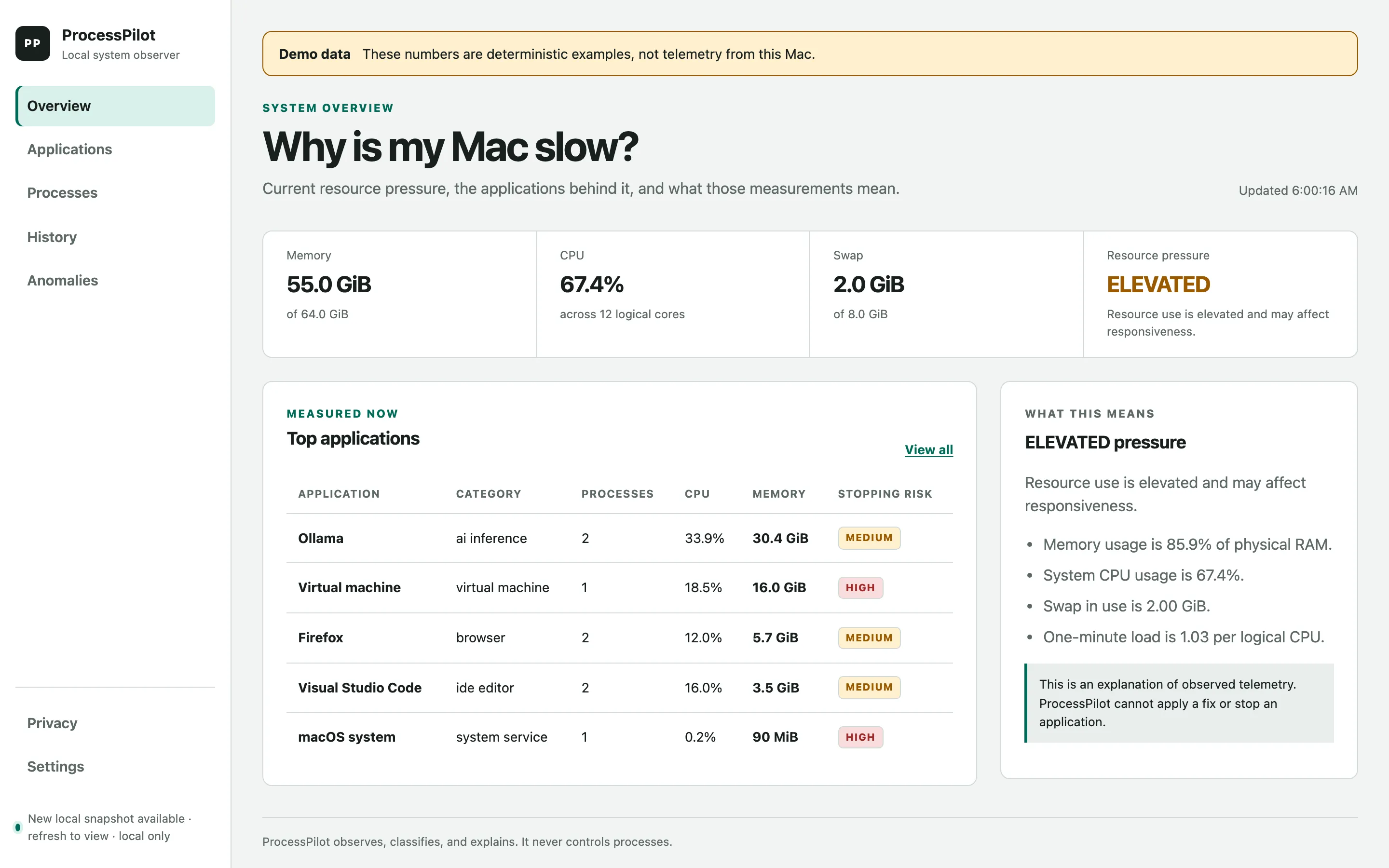
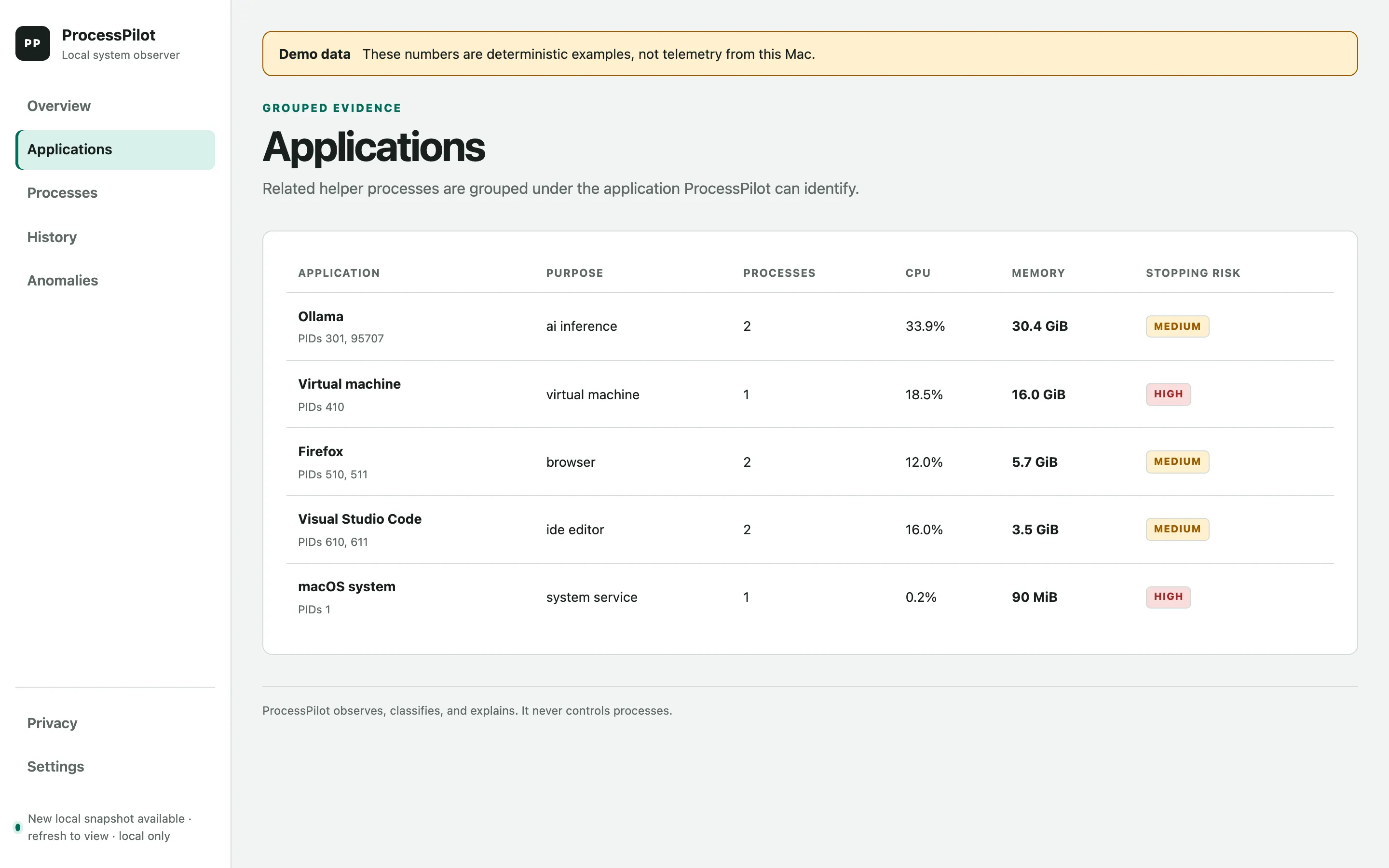
The web dashboard serves Overview, Applications, Processes, History, Anomalies, Privacy
and Settings pages. Every V1 API endpoint is a read-only GET below
127.0.0.1:
- /api/v1/system GET
- /api/v1/applications?page=1 GET
- /api/v1/processes?page=1 GET
- /api/v1/processes/{pid} GET
- /api/v1/history?application=… GET
- /api/v1/anomalies GET
- /api/v1/events (SSE) GET
Unknown query parameters and unsupported methods fail closed. There is no CORS opt-in, no command body, and no remote bind option.
04Engineering decisions
Engineering decisions
- Why two languages
- Rust owns the narrow, security-sensitive edge: raw telemetry, normalization, redaction. Go owns everything stateful and networked: supervision, validation, analysis, storage, HTTP. The boundary between them is a versioned, one-way JSON Lines pipe — the collector cannot be commanded, only read.
- Separating evidence from interpretation
- Observed facts, deterministic classification, conservative stopping risk, and optional explanation text are separate fields with separate rules. Applications are grouped without guessing unknown ownership.
- Optional AI, fenced in
- Explanations can come from a local Ollama model over a loopback-only, allowlisted payload — non-loopback endpoints, credentials in URLs, and redirects are rejected. If Ollama is unavailable, the deterministic explanation provider answers instead.
- Honest about signing
- V1 release archives are checksummed but not notarized — the project has no Apple Developer signing credentials, and the README says exactly that, recommending a from-source build over weakening Gatekeeper.
05Verification
The release gate runs the paranoid checks.
make check coordinates both languages; release CI additionally runs pinned
cargo audit, govulncheck, and npm audit. Browser tests
include automated WCAG 2.1 AA checks in desktop and mobile Chromium, and measured overhead is
recorded in the repository rather than claimed.
06Stack and links
Stack and links
Rust · Go · SQLite · Server-Sent Events · Playwright · GitHub Actions — with a Makefile coordinating the two toolchains into sibling binaries.
Repository · Privacy model · Threat model · Collector protocol · Releases